

BOO! Canva is a Gonna Get You!!! ☠️👹👻
Why Affinity going free isn't as wonderful as it sounds.

Hi,
Happy Halloween!!! I’ve got a scary story for you today. It’s about... corporate market capture?
Affinity is Free Now
Great news everyone! Yesterday Canva announced that Affinity (the design software originally developed by Serif, who Canva bought last year for AU$582 Million) is now totally free!
This is big news, and before I shit all over it I thought I’d at least share my most optimistic thoughts about it. Here goes.
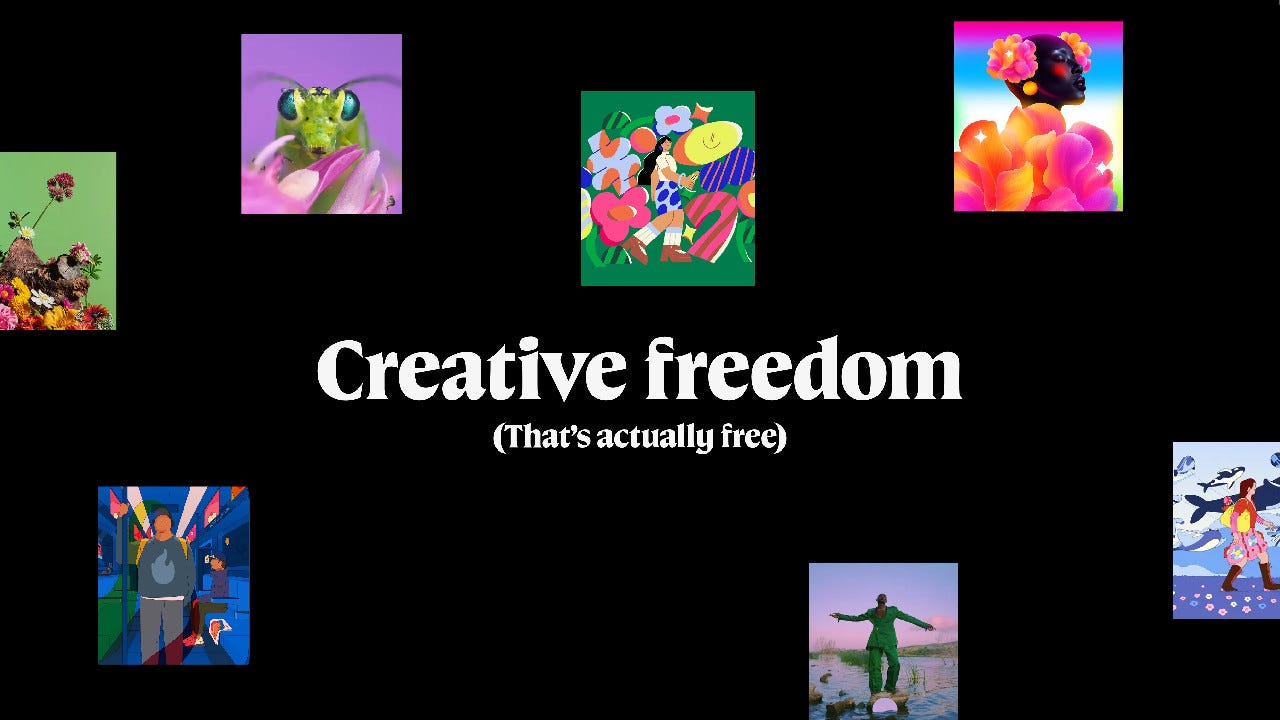
Good News?
Making Affinity, a fully-featured design suite, cost zero dollars to access is absolutely an improvement in terms of increasing accessibility of professional creative software. I think this will be a great boon for a lot of artists who are struggling to afford an expensive Adobe subscription, and, having used Affinity’s Version 2 suite since it launched in 2022, I do believe that for most Adobe users it can be a complete replacement for Adobe products.
So, more money stays in the pockets of artists, and a professional suite of design tools gets to become a new entry point for people who want to use them. As someone who has complained before about Adobe being the standard for so many creative industries, which forces students to learn these tools and become locked into their ecosystem, anything that can start to chip away at Adobe’s monopoly is a welcome change.
So why am I having to re-write this section so much to try to keep it “optimistic?”
What’s the catch?
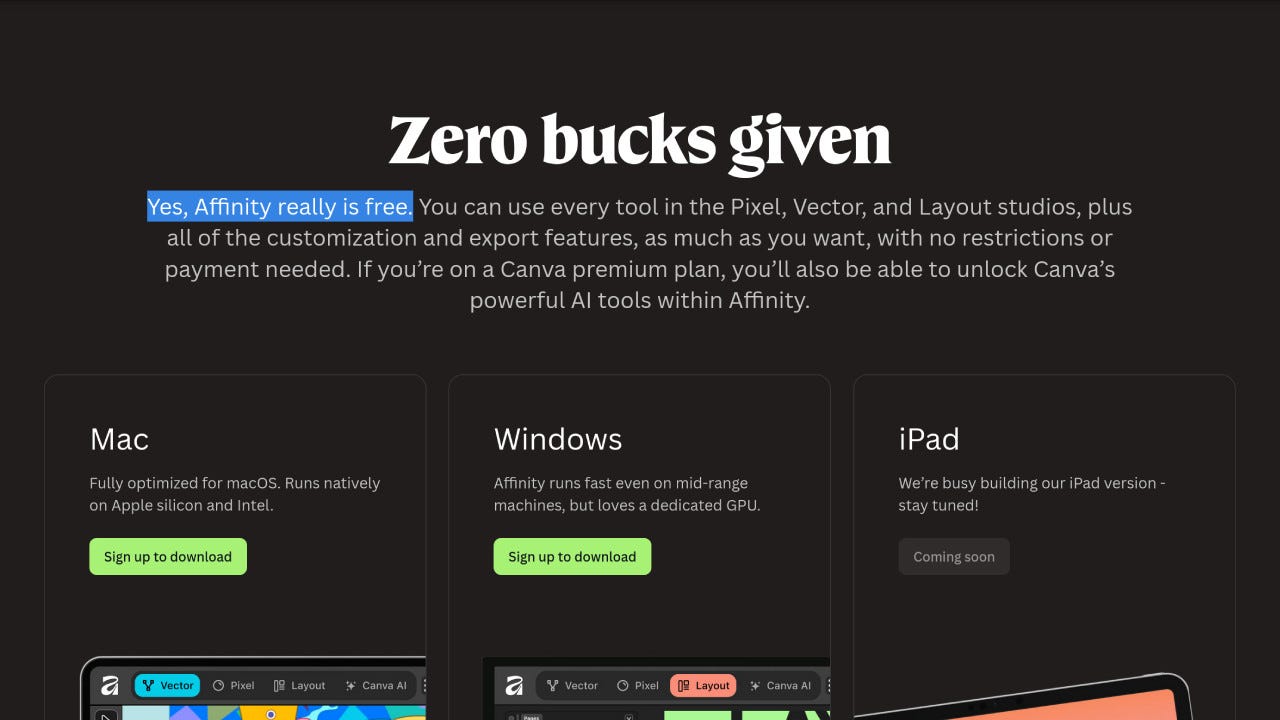
That’s the obvious question, right? What’t the catch? Canva spent half-a-billion (aussie) bucks on Affinity just to give it all away? That’s not how capitalism is supposed to work.
But the thing is, that’s how capitalism has been working for the last few decades. As tech companies have grown to become the most valuable companies in the world, a pretty standard practice for getting there has been to offer free services to people as a way of capturing markets and establishing global monopolies. Facebook, Instagram, Fortnite, TikTok, ChatGPT... all these services lure you in with the lowest possible barrier-to-entry: they’re free*.
*…in theory. For now.
Why this is so spooky
So why make this my Halloween post? What’s so scary about some free software? I think the main reason I find this news to be so disappointing and spooky is how it fits so perfectly into the trends of the last several years. We’re watching companies lobying for less regulation, rewrite the terms of sale after the fact and challenge the very definition of ownership in the digital age. There’s a reason that Cory Doctorow’s term “Enshittification” caught on: we all get it because we’ve all lived it.
Canva making Affinity free sounds great on paper, but it sends a chill up my spine. It gives me déjà vu. There’s something about the intense positive language and BOLD STATEMENTS ABOUT FREEDOM from Canva that make the whole thing feel off.
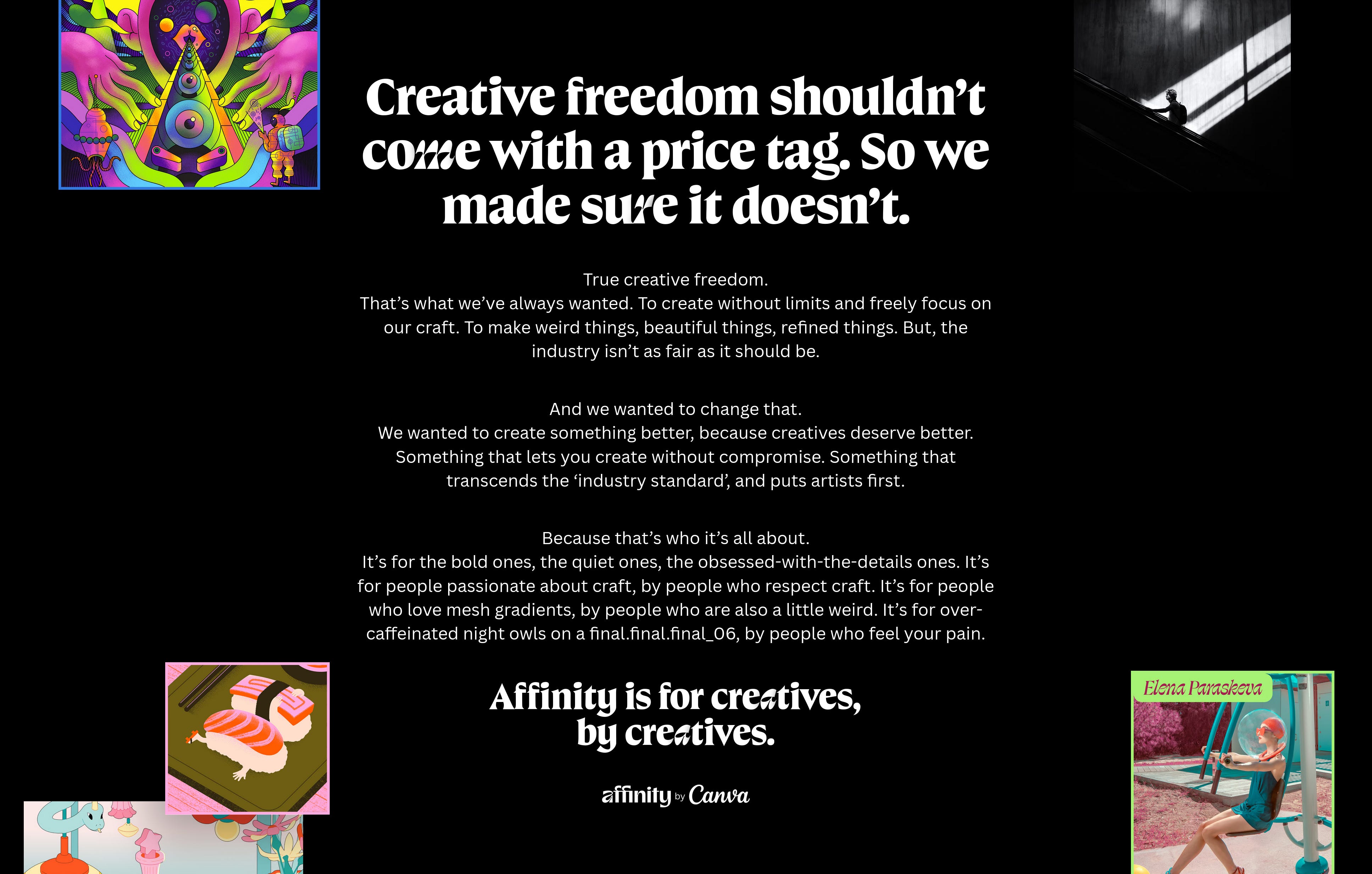
So I thought I’d dig into a bit of that language, share my thoughts about this news and what it could mean, and hopefully help clarify why so many people aren’t excited about this mythical free lunch.
Backstory
In 2022, Adobe announced their intention to acquire Figma for twenty BILLION dollars. This ended up triggering some much-needed anti-trust investigation from the EU, delaying the sale and eventually causing Adobe and Figma to call the deal off altogether. It was clear that Adobe, already a monopoly in the creative software industry, was simply too powerful to be allowed to absorb another platform as big as Figma.
At the time the purchase was announced, the Affinity twitter account posted this:
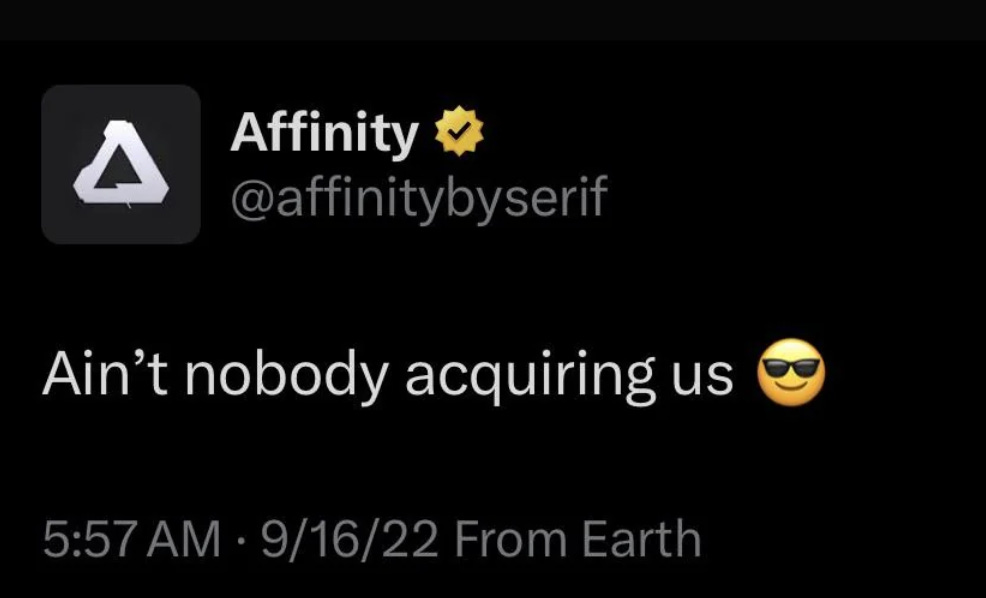
This smug statement was a savvy little way of highlighting the main value that Affinity had been nurturing in its customer base: they weren’t like Adobe. Affinity spent years positioning their products as being the “good guys” of design software. As people became more and more frustrated with Adobe for their price-gouging through ever-increasing subscription costs, Affinity gained a following for offering a one-time payment for a perpetual license for their software. You’d pay once, and the program was yours to use. Sounds crazy, right?
I don’t think it’s a stretch to say that, without Adobe pushing people so hard with their predatory pricing and anti-competitive business tactics, Affinity would have never grown the customer base that it did. Affinity’s tools are at the top of most lists when you search for “alternative to Adobe.” If you use Photoshop, Illustrator or InDesign, Affinity had a near one-to-one replacement for you at a fraction of the cost and without the subscription-based business model that basically nobody is a fan of except for investors and executives.
And so, Affinity grew. And merely two years after Affinity smugly declared “ain’t nobody acquiring us,” they announced that they had in fact been acquired by Canva in 2024.
The Price of Free
So Canva announced that Affinity is now a single application (Affinity “Studio”) and that it is 100% free for everyone, forever, no strings attached.
…Except for all the strings attached, of course.
What are the strings? The first is that you can end up paying for tools within Affinity Studio, if you want to use Canva AI in the application. That requires a subscription to Canva Pro. So... not free, but not a big deal since I doubt many people want or care about Canva AI tools.
The other strings? These are more ethereal and hard to describe. It’s difficult to put your finger on them. But digging into a bit of how Canva are talking about this move helps us understand things a bit better.
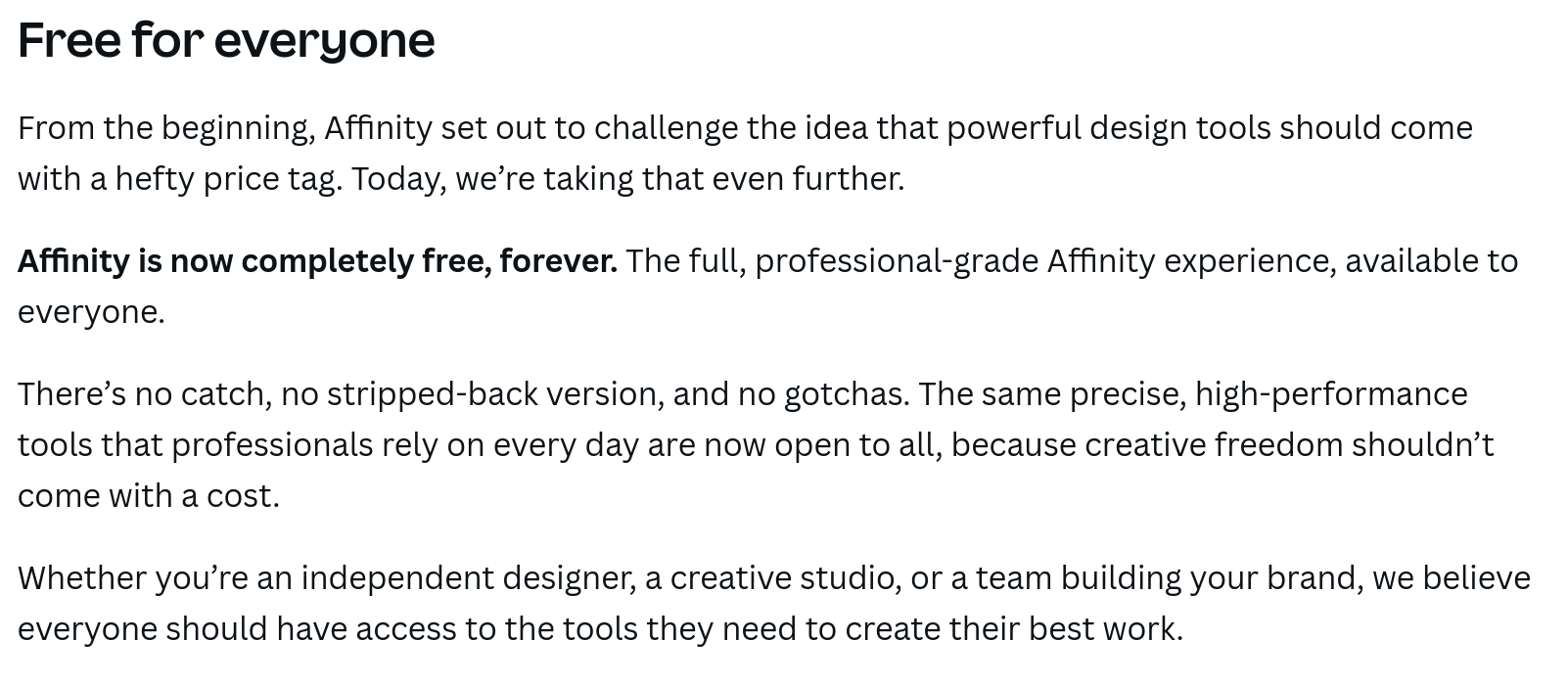
There’s no catch, no stripped-back version, and no gotchas. The same precise, high-performance tools that professionals rely on every day are now open to all, because creative freedom shouldn’t come with a cost.
~ via Canva’s Press Release
This kind of confident statement is exactly what I’m suspicious of, because you don’t buy a company for half a billion (Australian) dollars and then just give it all away for free. The most obvious string attached to this “freedom” is that this is clearly meant to make Affinity into a loss-leader to trap people in Canva’s ecosystem.
To say that Affinity now comes at no cost is to ignore the less tangible costs we’re all well acquainted with as users of tech products for the last twenty years. Does using Facebook or Instagram come “without a cost?” Sure, it seems that way monetarily, but we all now have an intuitive sense that this fails to capture the full picture. These companies use their platforms to lure you in, trap you and extract data, attention and, yes, even money from you once you feel invested and unable to leave.
Canva’s language around this news feels a lot like we’re mice being directed to “free cheese” by an altruistic cat.
“While our last decade at Canva has focused heavily on the 99% of knowledge workers without design training, truly empowering the world to design includes empowering professional designers too,” Canva said in a blog post. “By joining forces with Affinity, we’re excited to unlock the full spectrum of designers at every level and stage of the design journey.”
~ via Forbes.com.au (emphasis mine)
This quote comes from Canva’s original announcement of the acquisition of Affinity, and reveals another angle we can use to understand this new model.
Canva has an undeniable stigma attached to it on the part of legacy design professionals. Crusty old designers seem to see Canva as being the Microsoft Word-Art of the modern era, and I can speak from personal experience in saying that trying to use Canva when you’re used to professional design tools is extremely frustrating and off-putting. If Canva want to take on Adobe in the mortal combat of corporate stock value, then they do likely need to find a way to capture (or, in their words, “unlock”) the larger professional industry as part of their user base.
This duopolistic bickering isn’t one-sided either. I think Adobe validate Canva’s goals quite a lot here with their Adobe Express tools, which seem to be an attempt at the reverse of Canva’s switcheroo, to get non-designers to use simpler, lower-barrier-of-entry Adobe tools for their social media graphics and basic design jobs.
So Canva and Adobe are fighting for the same customer base, and Canva have specifically acquired Affinity in an attempt to expand their appeal for professional designers. If only they could come up with a way to make every Affinity user (people who have effectively self-identified as disliking Adobe) sign up for a Canva account...

There’s the other string attached. If you want to use the new Affinity app, you need to sign up for a Canva account if you don’t already have one. Why not, right? It’s free! And just like that, Canva has created a pipeline to onboard a whole suite of users who otherwise might be likely to shun their services as being too basic. New customers “unlocked.”
The AI Elephant in the Room
We know that transparency around AI use and data handling is essential, and your creative work will always remain yours. Canva AI features are built with privacy and control in mind, ensuring that your creative work in Affinity stays secure and is not used to train AI features.
~ via Canva’s Press Release
Then there’s the AI of it all. We all know that “AI” has essential just become executive-speak for “please invest more money,” and so Canva’s insistence that AI be front-and-centre in the new Affinity program makes a lot of sense. I can accept that some selection of people may actually like and use these tools, and it’s nice that they let you toggle them off from the UI if you are uninterested. However, for the vast majority of people this kind of AI is a nuisance being forced into every corner of our digital lives by companies desperately trying to seem on top of the latest trend.
All this AI isn’t packed into Affinity for you, it’s there for investors.
So Affinity is full of Canva AI now. But don’t worry, they know that “transparency” around AI is “essential.” So how transparent is it? Well, Canva have a big page about “AI Safety,” where, interestingly, they lead off on their commitments to safety with corporate indemnification. Surely that’s exactly the thing Affinity users are concerned about most, right?
Imagine if, before a project started, a designer told a client that they would indemnify them against any “accidental copyright infringement” they did in the work. Would that inspire confidence? Is it a good sign that this even needs to be said?
Canva’s language in their press release doesn’t really tell the whole story in terms of how they use your data to train their AI. While they say it’s not used, their actual AI policy statements make it clear that they’ve given themselves wiggle room, and there are settings you have to turn off to ensure they don’t use your data.
They specifically say this when they explain where their training data comes from (emphasis mine):
...Content from creators that are part of the Canva Creators program who have not opted out of their content improving our AI-powered features.
and imply it here, saying they do train their AI on:
User content where this is consistent with their Privacy Settings for improving Canva’s AI-powered features.
We know from what happened to Facebook when Apple made detailed tracking an “opt-in or out” prompt that when users have a clear option to avoid this kind of data harvesting, they take it. How much data do you think Canva would collect if all of this was opt-in? Would anyone help them out if you needed to dig through menus to turn it all on?
If Canva using your data to train AI doesn’t bother you, that’s fine, but that is another cost added to their “free” product. They’re getting something from you.
That isn’t “free.”
Privacy as Currency
So if Affinity is free, but you need to sign up for a Canva account to use it, there must be something about that account that adds value for Canva. The obvious thing is that it gets you in their ecosystem. They get your email, they get to talk to you and they get to try to make you feel great about their company. But what else do they do with that account?
To learn how these companies use the data we give them, especially for “free” services, it can be useful to actually look at their Privacy Policies and Terms of Service. I know. The Halloween theme continues. Reading the ToS? Terrifying.
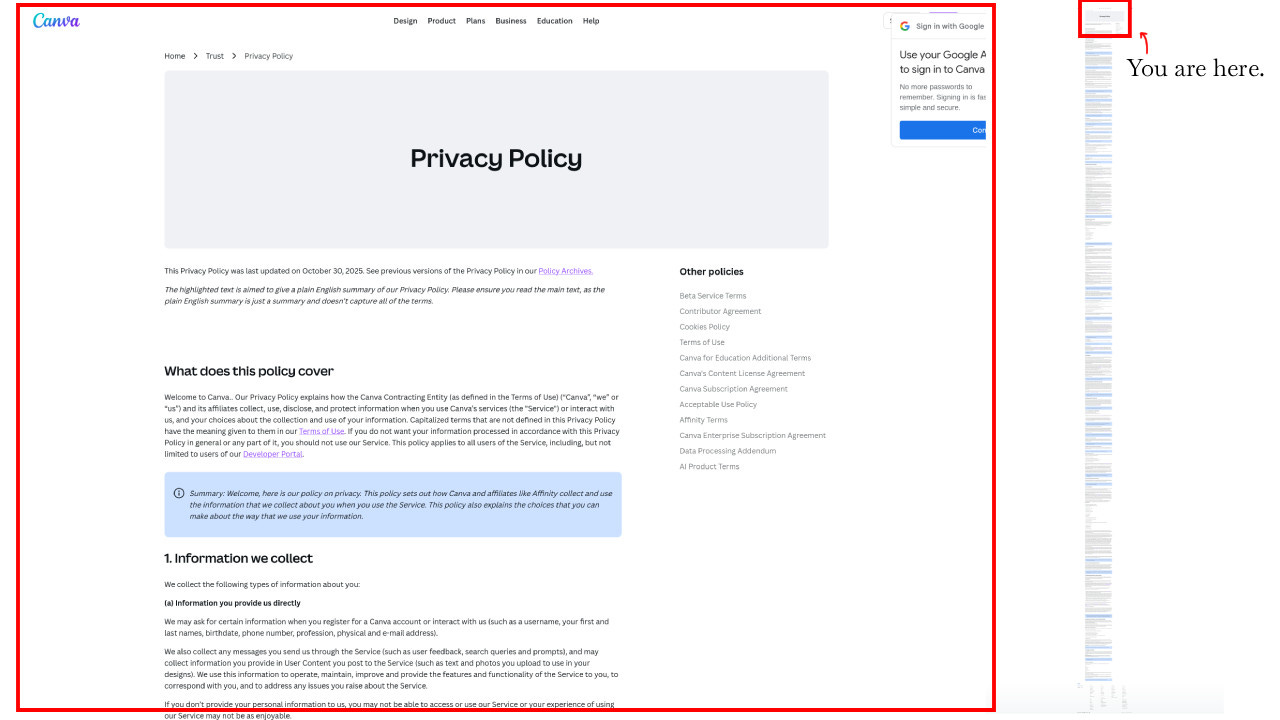
Screenshot of Canva’s entire Privacy Policy page. It’s very very long.In terms of actual Privacy Policies, Canva’s is just under 10,000 words (and their “Data Processing Addendum“ adds another 3,000), meaning it’s probably a bit more complex than they make it seem when they say “Canva AI features are built with privacy and control in mind.” Their human-readable statements on privacy really just amount to “trust us,” while their actual Privacy Policy is no more transparent than any other corporation’s. Do you think most Canva users will actually read this?
Thankfully, actual privacy-focused services exist like ToS;DR (Terms of Service, Didn’t Read), who crowd-source reviews of these gargantuan terms and policies from companies and grade them on a simple letter scale based on how much unnecessary, privacy-violating information they require. Facebook, Amazon and YouTube, for example, get graded E (very bad) whereas Wikipedia has a B and alternative search engine Startpage gets an A.
Canva gets a D. So, not as bad as the worst but not much better. Interestingly, reviewing Canva’s policies here reveals that, for some reason, using Canva services (like the new Affinity)...
tracks your physical location, even though it doesn’t need it for the services they provide
sets cookies for tracking you outside of providing their services (like saving you as logged in)
reserves the right to block any user-generated content (so they have the right to censor your work on their platform)
can delete your account at any time without notice (like, say, they don’t like the things you’re making on their platform)
tracks you via social media cookies
blocking cookies may limit your use of the service (so, blocking cookies that aren’t required for the service they provide can limit your use of the service)
posting of pornographic content is prohibited (and what is considered “pornographic” is obviously defined by them)
They may stop providing the service at any time
So, in reading all that, how “free” does it feel?
Now, to be fair to Canva, on this scale Adobe get an E. But, again, if we’re arguing between last place and second-last place, we need to recognize how pathetic this “privacy” commitment is.
The fact is that, to use Affinity’s new app, you need to sign in with a Canva account. And because of that, you need to agree to these D-Grade terms of service. That gives them in theory the ability to track your location for no reason, block or limit your use of the app if you try to block advertising and social media cookies, police the work you create with the app and put on their servers, delete your account for any reason, without notice, and completely stop providing the service at any time.
The Horror of a Services-Based Economy
The reality of this announcement is that, it’s a mixed bag. I really do find it hard to be excited about this, but then again, I have plenty of resources and access to creative software and have for all of my life. I can’t honestly say that people won’t benefit from this move, but I’m also unwilling to applaud anything a company like Canva does when they preach “freedom” at the same time as they force you to sign up for their accounts and lock up your work in proprietary file formats.
There are truly free alternatives to Canva and Adobe products, but they come with plenty of baggage, too. Open Source tools like Blender set the standard: they fund-raise well enough to build industry-leading tools that are actually free (no account required) and anyone can contribute to. But other open source tools like Inkscape, Gimp and Kdenlive are buggy, unintuitive and missing key features for a lot of professional work. Open Source could be a solution, but it isn’t a magic bullet and it requires people actually funding and supporting to tools they use.
Other free and cheap tools exist. Photopea is free but runs ads, which you can pay to remove. Procreate is a small enough team making a specific enough project that they can apparently afford to sell one-time licenses to their app for anyone with an iPad. In these cases, not being tied to a gigantic, multi-national corporation that’s eagerly anticipating their IPO seems to be a good way to make useful creative tools accessible to artists.
My point is simply that, despite what they say, we need to understand that using the new Affinity isn’t free. It just doesn’t cost you money. But it is definitely not free in the sense that it provides you with some kind of revolutionary freedom of access to or use of the app. The freedom Canva is offering is tangled in barely visible strings like cobwebs. They may not seem like much, but they stick to you and get in your mouth, and before you know it you’re covered in spiders trying to suck you blood.
Maybe I’m just being paranoid. Maybe I’ve become an overly eager luddite, trying to smash machines that aren’t harming anyone at all. We won’t actually know until some time passes what Canva will do, but don’t fall for their PR when they try to convince you that they’re just doing this for the good of humanity.
Ultimately, this is just another platform trying to capture market share, and the easiest way to do that is to lower the cost of entry. That’s really all this is. Just make sure that, if you venture into the trap, you have an escape plan in mind so you don’t get eaten.
Happy Halloween
Simon 🎃
My thoughts exactly and just when I wanted to start using Affinity Publisher for self publishing. Do you know if there are any other decent alternatives to Adobe In Design?